Posts tonen met het label Spain. Alle posts tonen

donderdag 18 april 2013

Cadaqués


I would love to show you a nice stamp, but surprisingly enough this card reached me with no stamp or cancellation whatsoever. Great it still arrived with no stamp and not any surcharge involved. Dominique, I will try to send you a card back asap!


For most of “cadaquesencs”, the local people, it is a special place, but for visitors it is more than a special place, for many people it is like an island, and for some others it is remote town, for the residents it is part of their life and for holidaymakers it is like home… Cadaqués offers a great deal of sensations, experiences and values.

With a population of about 3,000 inhabitants, Cadaqués economy is based on tourism, an activity which has consolidated as the town’s main economic engine.
[source: visitcadaques.org]


Merci beaucoup Dominique! 

zondag 10 maart 2013

Santander


Santander is an elegant city which extends over a wide bay with views of the Cantabrian Sea. Its historic quarter includes a group of majestic buildings which are situated against an incredible natural backdrop of sea and mountains. Its marine and commercial tradition is linked to a century old history of tourism, which has its main attractions in the famous El Sardinero beach, the promenade and the La Magdalena peninsula. The cultural wealth of the Cantabrian capital is enriched with the passage of the Pilgrim's Road to Santiago de Compostela and the neighbouring Altamira Caves, both of which have been declared World Heritage.

Santander is a city in which the mixture of its various vocations, seafaring, commercial and tourism traditions, remains patent. The city's origin is related to the Portus Victoriae founded by the Romans. However, the capital's urban development was not to come about until the XI c. when the town began to grow around the San Emeterio abbey. From its Latin name, Sancti Emeterii, comes the current name of Santander.

During the XVIII and XIX centuries, the city became a key trading port for the maritime routes between Castile and the American colonies. From around the middle of the XIX century, Santander became one of the most exclusive summer tourist destinations on the northern coast of the Iberian peninsula.
[source: Spain.info]


Thank you very much Mario!

donderdag 24 januari 2013

Common genet


I learned something new today! I seriously never knew these creatures were existing. The common genet is apparently well spread throughout Southern Europe and Africa, but I've never seen one in real life, the zoo or on TV. And the stamp is in my opinion a really good one since it warns people to pay attention while driving and not to play with your mobile phone. I absolutely abhor people who even dare to touch their phones while driving, so I'm glad this topic receives a lot of attention, even through stamps. The text on the screen says : ¡Pierde la llamada. no la vida! which means 'Lose the call, not your life!' if my Spanish doesn't fail me. And ¡Atento a la condución! means 'Pay attention to driving!'


The common genet, genetta genetta, is also known as both the European and small-spotted genet. They measure 32 to 42 inches (80 to 106 centimeters) long from head to tail, with males being ever so slightly longer than females. They are not heavy creatures, weighing in at 3 to 5.5 pounds (1.4 to 2.5 kilograms). The common genet has a fur coat that is yellowish-gray in color and covered in black spots as well as stripes running across its tail. They have rounded ears, brown eyes, large heads, and white patches beneath the eyes as well as near the tip of their pointed muzzle. They also have retractable claws, much like a cat, which they use to climb trees with minimal effort.

The common genet can be found in Africa and Europe, and the Middle East. They prefer to live in dry areas like rocky hills and Mediterranean woodlands. This creature will often make its home where its favorite food source, the wood mouse, is abundant and where they can be protected by the vegetation from predators. They are primarily nocturnal animals, hunting at night and resting during the day. It is not uncommon however, for young ones to be seen moving about in the daylight. Even though males and females may have home ranges that overlap, these animals are primarily solitary creatures.

The diet of a common genet consists of small mammals, birds, insects, amphibians, lizards, fruits and eggs. Their use their impeccable senses of smell and hearing to help track down their prey. They will also climb trees in order to steal eggs from time to time. Common predators of these animals needs include snakes, leopards and owls. [source: voices.yahoo.com]


Thank you very much Magdalena and Walter!/ ¡Muchas gracias Magdalena y Walter!

maandag 5 november 2012

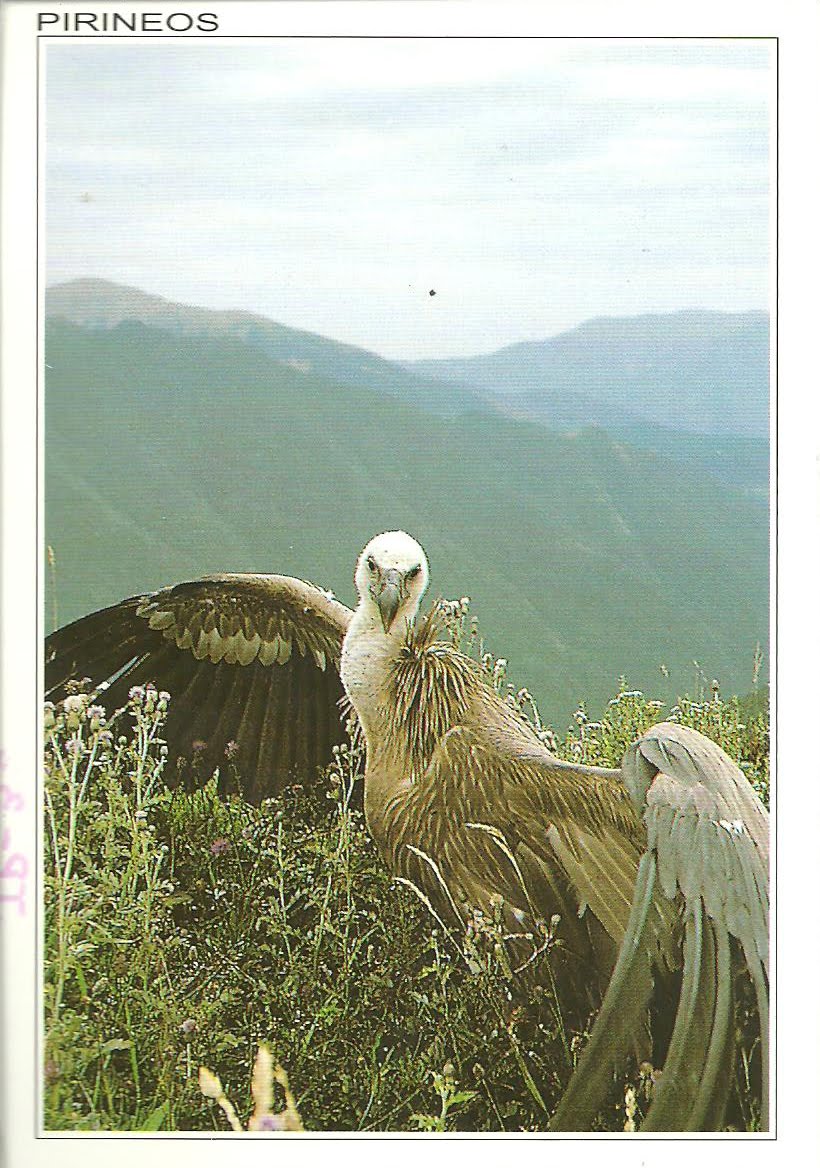
The griffon vulture in the Pyrenees


The Griffon Vulture (Gyps fulvus) is a large Old World vulture in the bird of prey family Accipitridae.

Like other vultures, it is a scavenger, feeding mostly from carcasses of dead animals which it finds by soaring over open areas, often moving in flocks. It establishes nesting colonies in cliffs that are undisturbed by humans while coverage of open areas and availability of dead animals within dozens of kilometers of these cliffs is high. It grunts and hisses at roosts or when feeding on carrion.
The maximum lifespan recorded for the Griffon Vulture is 41.4 years, for a specimen in captivity.
It breeds on crags in mountains in southern Europe, north Africa, and Asia, laying one egg. Griffon Vultures may form loose colonies. The population is mostly resident. Juveniles and immature individuals may migrate far or embark on long-distance movements. [source: wikipedia]